

Civil aerospace simulation and training: Key Research Findings
- Increased inclination towards simulation-training
- PC-based Technologies Defining Market Upturn
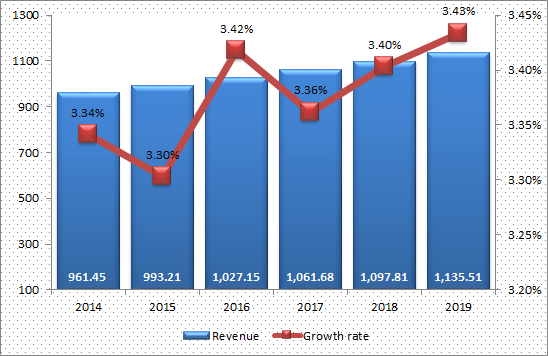
Technavio has added a new report on the Global Civil Aerospace Simulation and Training Market 2015-2019 to its range of reports on civil aviation simulation and training. Analysts predict that the global civil aerospace simulation and training market will grow at a CAGR of over 4% between 2015 and 2019, in terms of revenue. EMEA is leading the market with a value of around US $961 million in 2014, and is expected to occupy a major market share of 35%, followed by the Americas, APAC, and ROW by 2019.
The new research report from Technavio provides an in-depth analysis of the major drivers and trends responsible for growth, as well as highlights the segments possessing all-out growth potential.
Civil Aerospace Simulation and Training Market in EMEA 2014-2019 ($ millions)
Source: Technavio Research
Owing to greater cost-effectiveness and less time consumption than traditional training, there is a noticeable shift towards simulator-based training, which includes both academic and flight simulator training. To increase aviation safety and reduce carbon emissions, flight simulators are being proposed to train pilots, to help reduce environmental hazards. The flight crew has to undergo two days of training and testing in a flight simulator every six months.
“Simulators are trending towards the use of PC-based technologies and are utilizing new technologies such as computer graphics, mechanical actuation, and distributed computing, which are improving the features of flight simulators, says Sriram Mohan, Lead Analyst, Aerospace and Defense, Technavio Research.
“Thanks to greater computing speeds, improved memory capacity, and improved image producing capabilities, high-performance simulators are entering the market. Moreover, simulators are impelling toward the usage of mobile technologies such as tablets,” says Mohan.
Some of the most prominent vendors dominating the civil aerospace simulation and training market include CAE, L3 Link, FlightSafety International, AXIS Flight Training, and Rockwell Collins. Of late, CAE and L-3 Link are the two leading vendors in manufacturing flight simulators concentrating on developing technologies that are used in flight simulators.
https://www.technavio.com/%3Cp%3EMore%20detailed%20analysis%20is%20availa…